
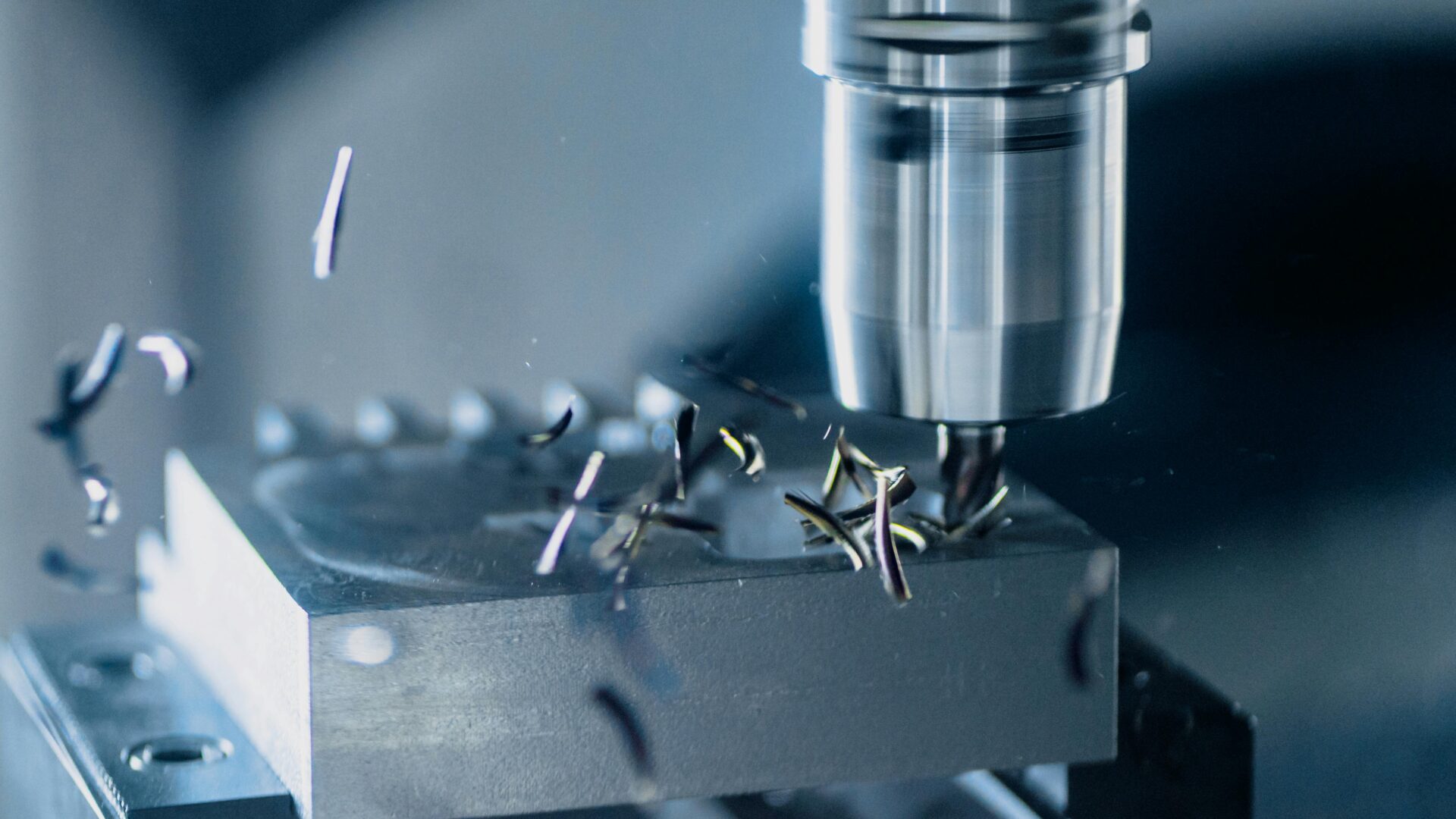
Chatter is one of the most persistent problems in CNC turning. It shows up as a harsh vibrating sound, leaves wave patterns on the machined surface, and forces operators to back off on cutting parameters that would otherwise be perfectly achievable. If you’ve ever reduced depth of cut just to get a stable cut, you’ve already let chatter dictate your process.
This article covers what causes chatter in turning, why conventional tool holders struggle with it, and how vibration damped tool holders — specifically those using a self-tuning mass damper — eliminate the problem at the source.
What chatter actually is
Chatter is regenerative vibration. During a cut, the tool deflects slightly under cutting forces. That deflection leaves a waviness on the workpiece surface. On the next pass, the tool cuts that wavy surface, which generates a varying chip thickness, which creates varying cutting forces, which amplifies the deflection further. The system feeds back on itself until the vibration becomes self-sustaining.
The result: poor surface finish, accelerated insert wear, noise, and in severe cases, damage to the spindle or workpiece. In internal turning and boring — where tools are clamped at one end and extend unsupported into a bore — the problem is especially acute. The longer the overhang relative to the tool diameter, the lower the natural frequency of the tool, and the easier it is for the cutting process to excite that frequency.
A length-to-diameter ratio above 4:1 is where chatter typically becomes a serious issue. At 6:1 or beyond, it’s often the limiting factor on what’s machinable at all.
Why standard tool holders don’t solve it
The conventional response to chatter is to adjust cutting parameters: reduce cutting speed, lower depth of cut, change feed rate. Sometimes this works. More often it moves the problem rather than removing it — the system finds a new unstable frequency, or the adjusted parameters bring their own productivity penalty.
Rigid tool holders transmit vibration directly. They have no mechanism for absorbing energy from the cutting process. Adding more clamping force or switching to a stiffer holder material helps at modest overhangs but does very little once the ratio pushes past 4:1.
Some operators try to address chatter with external dampening — rubber mounts, auxiliary masses attached to the tool. These are rarely tuned to the specific frequency of the tool in use, which means their effectiveness is inconsistent and difficult to predict.
How vibration damped tool holders work
A vibration damped tool holder contains an internal damping mechanism — a mass suspended inside the tool body with a viscoelastic interface that absorbs vibrational energy before it can build up into chatter.
The principle is called a tuned mass damper. A secondary mass inside the tool is set to resonate at the same frequency as the tool’s natural frequency. When the tool begins to vibrate, the internal mass moves out of phase with it, transferring energy away from the tool body and dissipating it as heat through the damping material. The vibration is absorbed rather than transmitted.
The key word here is “tuned.” A tuned mass damper is only effective if it’s matched to the specific frequency of the tool. That’s where the design of the damping system matters enormously.
Self-tuning mass dampers: what makes them different
A self-tuning mass damper (STMD) adjusts automatically to the resonant frequency of the specific tool configuration in use. Rather than being pre-set at the factory for a single frequency, the damping mechanism adapts to the actual dynamic behaviour of the tool — accounting for variations in overhang length, clamping conditions, and the material being cut.
This matters in practice because no two setups are identical. A boring bar clamped 80 mm from the insert has a different natural frequency than the same bar clamped at 95 mm. A fixed-frequency damper tuned at the factory may be significantly off once the tool is mounted in production conditions.
STMDs built around nanostructured polymer technology take this further. Nanostructured polymers have viscoelastic properties that can be engineered with precision — controlling stiffness and damping coefficient across a specific frequency range. This enables a more effective and reliable damping response than conventional elastomers, particularly at the high cutting speeds used in modern CNC turning.
The practical result is a tool holder that suppresses chatter across a wider range of conditions, without requiring the operator to manually tune anything. It’s plug and play vibration damping.
What this enables in the machine
The effect of effective chatter suppression isn’t just a smoother cut. It changes what parameters are possible.
Surface finish improves — not as a side effect, but as a direct consequence of the vibration being controlled. Ra values that were previously unachievable at productive cutting parameters become routine. For components with tight surface finish requirements in deep bores or long internal features, damped tooling is often what makes the tolerance achievable at all.
Insert life follows the same pattern. Chatter is mechanically aggressive on cutting edges. Stabilising the cut extends insert life, reducing both cost and the frequency of tool changes during a run.
Where damped tool holders have the most impact
Not every turning operation needs a damped holder. For short overhangs with standard length-to-diameter ratios below 3:1, a rigid holder is usually sufficient. The investment in adaptive vibration damping tools pays off most clearly in specific conditions:
Internal turning at long overhang. This is the primary use case. Bores that are deep relative to their diameter force the use of long, slender tools. The physics work against stability, and damped tooling directly addresses the cause.
Difficult materials. Titanium, hardened steels, and other materials that generate high cutting forces or have low thermal conductivity put more energy into the tool. The vibrational load is higher, and the risk of chatter is correspondingly greater.
Thin-walled components. When the workpiece itself is flexible, it contributes to the vibrational system. Damped tooling reduces the energy being introduced into the cut, which helps even when the workpiece — not the tool — is the weak link.
High-speed roughing. Chatter-free machining at high speeds is achievable with damped holders where it isn’t with conventional tooling. This is particularly relevant in operations that need to push material removal rates while still meeting surface finish requirements downstream.
Selecting the right damped tool holder
A few parameters determine which holder is appropriate for a given application:
Overhang length. Match the holder’s rated effective damping range to your actual length-to-diameter ratio. Most manufacturers specify the range over which the damper performs effectively.
Bore diameter and depth. These constrain the holder’s body diameter, which in turn affects rigidity and the space available for the internal damping mechanism.
Coupling interface. Damped tool holders are available for multiple machine interfaces — capto, HSK, cylindrical shank. The interface must match the machine spindle and provide sufficient clamping rigidity for the damping mechanism to function correctly. A poorly clamped holder undermines the damping performance.
Insert geometry and application. The holder is only one part of the system. Insert selection — geometry, grade, coating — should be aligned with the material and the improved cutting conditions that damped tooling enables. There’s no point in specifying a damped holder with an insert geometry that limits performance independently.
Common mistakes when implementing damped tooling
Under-clamping the holder. The damping mechanism depends on the tool body being rigidly fixed at the clamp. Inadequate clamping torque introduces compliance at the wrong point and reduces the effectiveness of the internal damper.
Keeping the same parameters as before. Operators sometimes install a damped holder and run it at the same conservative parameters they used with a standard holder. The damping is working, but the productivity gain isn’t being captured. Test the limits. The holder exists to allow more aggressive parameters — use them.
Applying damped holders at short overhangs to solve other problems. If chatter is occurring at a 3:1 ratio, the cause is usually elsewhere — insert geometry, worn cutting edge, incorrect cutting speed, workpiece fixturing. A damped holder won’t fix a problem that isn’t fundamentally about overhang-induced vibration.
Ignoring the complete system. Tool holder, insert, machine, fixturing, and workpiece all contribute to the dynamic behaviour of the cutting system. Damped tooling eliminates one major source of instability, but a workpiece with inadequate support, or a machine with worn spindle bearings, will still generate vibration problems.
Summary
Chatter in CNC turning is a structural problem caused by regenerative vibration. At long overhangs, standard rigid tooling cannot prevent it — the physics don’t allow it. Vibration damped tool holders with self-tuning mass dampers address the problem directly by absorbing vibrational energy inside the tool, before it builds into chatter.
The result is stable machining at parameters that rigid tooling cannot sustain: higher depth of cut,better surface finish, and longer insert life. For internal turning operations at 4:1 overhang and above, this isn’t a marginal improvement — it’s the difference between a process that works and one that doesn’t.