
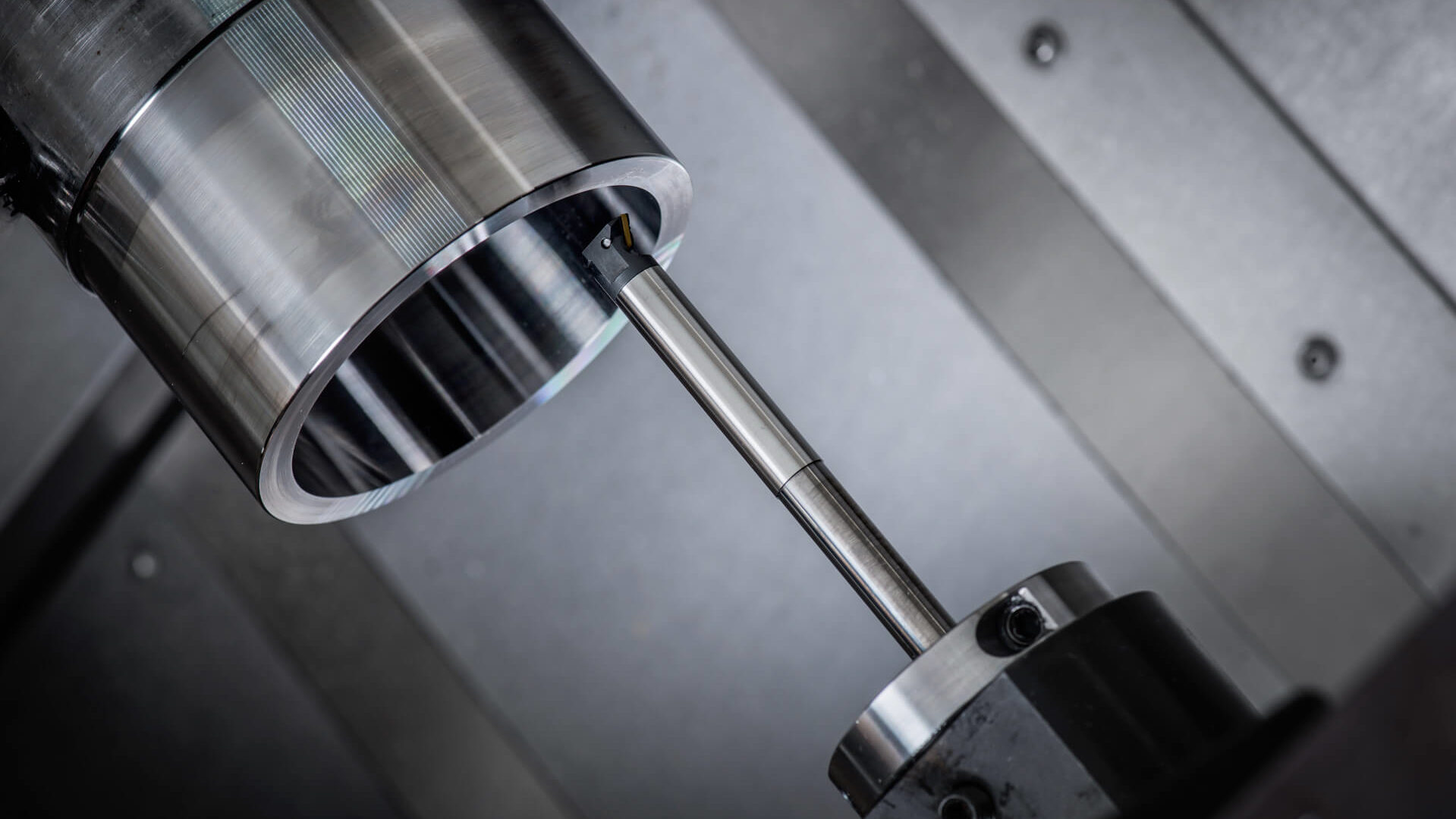
Deep hole boring is where vibration stops being an inconvenience and starts being a fundamental engineering constraint. The longer the tool extension, the lower the natural frequency of the bar, and the more susceptible the system becomes to chatter. At a certain point — typically around 4:1 length-to-diameter ratio — a standard boring bar simply cannot deliver acceptable results regardless of how carefully the operator dials in the parameters.
Vibration damped boring bars exist to push that limit outward. This guide covers what to look for when selecting one, how the damping technology affects real-world performance, and which application conditions separate a good damped bar from one that underdelivers.
Why boring bars are especially vulnerable to chatter
A boring bar is a cantilever. One end is clamped in the machine; the other end holds the insert and is completely unsupported. Every cutting force applied at the insert tip creates a bending moment along the full length of the bar. The longer the unsupported length relative to the bar’s diameter, the greater the deflection under load — and the lower the frequency at which the tool will naturally vibrate.
That natural frequency is what determines chatter susceptibility. When the cutting process generates forces at or near the tool’s natural frequency, vibration builds up rapidly. In a standard steel boring bar, the natural frequency drops off quickly as overhang increases. At 6:1, you’re typically looking at a natural frequency low enough that almost any practical cutting speed will excite it.
The consequence is familiar: visible chatter marks on the bore wall, Ra values that miss tolerance, accelerated insert wear, and an operation that requires constant parameter adjustments to stay in a narrow stable cutting window — if a stable window exists at all.
What vibration damped boring bars do differently
A vibration damped boring bar contains an internal mass damper — a precisely engineered mass housed inside the bar body, connected to it through a damping medium. When the bar begins to vibrate under cutting forces, the internal mass moves out of phase with the bar, transferring vibrational energy into the damping medium where it dissipates as heat.
The mechanism is a tuned mass damper. Its effectiveness depends entirely on how well the internal mass is tuned to the natural frequency of the bar in its actual operating configuration. This is the most important technical distinction between different damped boring bars on the market.
A fixed-frequency damper, tuned at the factory, will perform well at the specific overhang and clamping conditions it was designed for. Deviate from those conditions — clamp the bar at a different depth, change the extension length, use a different machine interface — and the damper frequency drifts away from the bar’s actual natural frequency. The damping effect weakens, sometimes significantly.
A self-tuning mass damper (STMD) addresses this by adapting automatically to the actual dynamic behaviour of the bar in the setup as configured. The damping mechanism adjusts to the resonant frequency of the tool under real operating conditions rather than factory test conditions. This makes it robust across the range of setups a production environment actually encounters.
The role of nanostructured polymer damping
The material that connects the internal mass to the bar body is not a minor detail. Conventional elastomers used in damped tooling have viscoelastic properties that vary with temperature and frequency in ways that are difficult to control precisely. As the bar heats up during a long cut, or as the frequency of vibration shifts with changing cutting conditions, the damping behaviour changes.
Nanostructured polymer technology allows the damping material to be engineered with a high degree of precision — controlling stiffness and loss factor within a defined frequency range. The result is more consistent damping performance across a wider range of operating temperatures and cutting conditions. It also enables a higher damping coefficient within the space constraints of a boring bar body, which is particularly relevant for smaller diameter bars where the volume available for the internal mechanism is limited.
For deep hole machining, where cuts are long and thermal conditions in the tool change over the duration of the pass, stable damping performance across varying temperatures is a real practical advantage.
Key specifications to evaluate
When selecting a vibration damped boring bar for a specific application, these are the parameters that determine whether it will perform:
Maximum effective overhang ratio. This is the primary specification. Most damped boring bars are rated to a maximum L/D ratio — commonly between 6:1 and 10:1. Understand what that rating means for the specific bar design: is it the theoretical limit of the damping mechanism, or the point at which the bar has been tested and validated under production conditions? The difference matters.
Frequency tuning range. A self-tuning damper that adapts across a range is more versatile than a fixed-frequency design. For shops running multiple setups with the same bar at different extensions, this directly affects how reliably the bar performs across those jobs.
Bar body material. Carbide boring bars have significantly higher stiffness and density than steel. This raises the natural frequency of the bar at a given overhang, which shifts the problem zone to longer extensions. Carbide also has higher inherent damping than steel. For overhangs up to around 5:1 or 6:1, a high-quality carbide bar without active damping can be sufficient. For longer extensions, active damping built into a carbide body gives both the stiffness advantage and the energy absorption.
Coupling interface. The bar’s connection to the machine spindle must be rigid. Any compliance at the coupling point undermines the damping mechanism — the damper is tuned to the bar body, and if the bar is moving at the clamp, the system is behaving differently than designed. Precision interfaces with defined clamping torque specifications are important here.
Insert compatibility. The bar must accept the insert geometry appropriate for the bore diameter and material. Some damped bars are available with multiple head options — different insert seats, different geometries — which extends their application range.
Coolant through. For deep hole boring, internal coolant delivery is often essential for chip evacuation. Verify that the damped bar supports through-tool coolant and that the coolant path design doesn’t compromise the structural integrity or damping behaviour of the bar.
Performance differences in practice
The difference between a standard boring bar and a well-designed damped bar becomes stark at overhangs above 5:1.
Surface finish is where the improvement is most immediately visible to the operator. Chatter leaves characteristic wave patterns on the bore wall with a periodicity directly related to the vibration frequency. A damped bar producing a stable cut delivers a surface that meets finish requirements without secondary operations. For precision bores with tight Ra requirements, this is often the deciding factor — not just productivity, but whether the part is even machinable to specification.
Insert life also improves substantially. Chatter applies highly variable, impulsive loads to the cutting edge. These loads crack and chip inserts in ways that steady cutting forces don’t. Stabilising the cut extends insert life and reduces the frequency of tool changes, which matters particularly in long-run production and in unmanned or lights-out machining where interrupt events are costly.
Application conditions where damped bars are essential
Not every boring application requires active damping. A short, rigid bar in a wide bore at modest overhang will machine cleanly with a standard holder. Damped bars earn their keep in specific conditions:
Deep narrow bores. When bore depth significantly exceeds bore diameter, the bar diameter is constrained and the overhang grows. This is the canonical use case for vibration damped boring bars. Hydraulic manifolds, pump housings, valve bodies, aerospace structural components — any application where geometry forces a long slender tool into a small diameter bore.
Difficult-to-machine materials. Titanium alloys, nickel superalloys, hardened steels, and other materials with high specific cutting forces or poor thermal conductivity put more energy into the tool per unit of material removed. The excitation that drives chatter is stronger, and the stable cutting window is narrower. Damped tooling expands that window in materials where standard bars have almost none.
Precision bore finishing. Even at moderate overhangs, a damped bar can improve surface finish and dimensional consistency on tight-tolerance bores. The elimination of micro-vibration that doesn’t rise to audible chatter but still affects Ra values is a real benefit in finishing operations.
Long production runs. In high-volume production, consistency matters as much as peak performance. A damped bar reduces process variation — fewer scrap parts, fewer interruptions for tool changes, more predictable cycle times. The economics become clear when calculated across thousands of parts.
Unmanned machining. When a machine is running unattended, the consequences of chatter are worse — a problem that could be caught and corrected by an operator in one or two parts can run for an entire shift. Damped tooling reduces the risk of chatter onset during unmanned cycles.
Setup and clamping: getting the most from a damped bar
A vibration damped boring bar is only as effective as its setup. Several setup factors directly affect performance:
Clamping depth and torque. Follow the manufacturer’s specification for minimum clamping depth and torque values. Under-clamping allows the bar to move at the clamp, which changes the dynamic behaviour of the system and reduces damping effectiveness. Many damped bars are designed with the assumption of a specific clamping condition — deviating from it means the damper frequency no longer matches the bar’s actual natural frequency.
Overhang length. Set the shortest overhang that the bore geometry allows. Even a self-tuning damper performs better closer to its design centre. More importantly, unnecessary overhang reduces rigidity and raises cutting forces — both of which work against stability even with active damping.
Cutting parameters. Start at the manufacturer’s recommended parameters for the bar and material combination. With effective damping in place, these will typically be significantly more aggressive than what you’d run with a standard bar. Test the limits methodically — increase depth of cut in steps, monitor the cut audibly and through surface finish, and establish the actual stable boundary for the setup.
Runout. Check runout at the insert tip after clamping. Excessive runout causes periodic variation in chip thickness that contributes to vibration independently of chatter. Damped tooling reduces chatter but doesn’t compensate for poor setup elsewhere in the system.
Matching the bar to the machine
The boring bar doesn’t operate in isolation. The machine’s spindle rigidity, the fixturing of the workpiece, and the condition of the machine tool all affect the dynamic behaviour of the complete cutting system.
A damped boring bar controls vibration in the bar itself. If the workpiece is poorly supported — thin walls, inadequate fixture contact, flexible setup — workpiece vibration can be the primary source of instability, and the bar’s damping won’t address it. Similarly, a machine with worn spindle bearings introduces a compliance that the bar cannot compensate for.
For deep hole boring on CNC lathes and machining centres, a few machine-side factors are worth checking before attributing instability to the tooling: spindle bearing preload, turret or head rigidity, workpiece fixture contact area, and tailstock support where applicable.
Summary
For deep hole boring at overhangs above 4:1, vibration damped boring bars are not a premium option — they are the practical solution to a physics problem that standard tooling cannot overcome. The key performance differentiator between designs is the damping mechanism: a self-tuning mass damper built around precise polymer damping technology outperforms fixed-frequency designs across the range of setups a real production environment encounters.
When selecting a damped bar, confirm the coupling interface provides adequate rigidity, and ensure the bar accepts the insert geometry of your material and bore finish demand. Set it up to specification, run at the parameters the damping enables, and the improvement in surface finish, insert life, and process stability will be measurable from the first part.